

Marijuana news: Legalized pot in U.S. spurs growth in heroin trade
By Noelle Crombie | ncrombie@oregonian.com
on April 07, 2014 at 8:30 AM, updated April 07, 2014 at 8:50 AM
Mexican marijuana growers are adapting to decriminalized pot in parts of the United States by making investments in heroin production.
The Washington Post offer's a grim look at how Mexican drug cartels are shifting their business strategies away from marijuana. The wholesale price of marijuana has plunged, forcing growers to make inroads in other drugs.
Some are cultivating poppy farms; The Post reports seizures of heroin at the U.S.-Mexico border have skyrocketed.
Washington Post staff writer Nick Miroff reports:
Farmers in the storied "Golden Triangle" region of Mexico'??s Sinaloa state, which has produced the country's most notorious gangsters and biggest marijuana harvests, say they are no longer planting the crop. Its wholesale price has collapsed in the past five years, from $100 per kilogram to less than $25.
"It's not worth it anymore," said Rodrigo Silla, 50, a lifelong cannabis farmer who said he couldn't remember the last time his family and others in their tiny hamlet gave up growing mota. "I wish the Americans would stop with this legalization."
Growers from this area and as far afield as Central America are sowing their plots with opium poppies, and large-scale operations are turning up in places where authorities have never seen them.
The New York Times' Adam Nagourney reports on the disconnect between Democratic governors and voters when it comes to cannabis policy. Governors like California's Jerry Brown are finding themselves at odds with the public, which increasingly supports legalization.
Even with Democrats and younger voters leading the wave of the pro-legalization shift, these governors are standing back, supporting much more limited medical-marijuana proposals or invoking the kind of law-and-order and public-health arguments more commonly heard from Republicans. While 17 more states â?? most of them leaning Democratic â?? have seen bills introduced this year to follow Colorado and Washington in approving recreational marijuana, no sitting governor or member of the Senate has offered a full-out endorsement of legalization. Only Gov. Peter Shumlin, a Democrat in Vermont, which is struggling with a heroin problem, said he was open to the idea.
Maryland appears headed toward decriminalizing small amounts of marijuana, The Baltimore Sun reports.
Maryland Gov. Martin O'Malley has said he'll keep an open mind when considering whether to sign the bill, the newspaper reports.
If O'Malley signs the measure, Maryland would become the 18th state to stop treating simple possession as a criminal offense, according to the Marijuana Policy Project. Two of them, Colorado and Washington, have legalized the regulated sale of the drug for recreational use.
The Maryland decriminalization legislation defines a small amount as 10 grams, a smaller amount than in most states.
The House acted on marijuana after the Judiciary Committee voted 13-8 earlier in the day to reverse its previous decision to approve only setting up a task force to study changes to marijuana laws.
And finally, The Oregonian editorial board over the weekend weighed in on an upcoming marijuana conference that's closed to the public and the press.
It's a perfect opportunity for Oregonians to learn from those who fear marijuana's legalization the most. And that's why it is flummoxing that the media is barred from the $250-a-ticket event and the nonpaying public unwelcome. Calls by The Oregonian's editorial board to the Mount Hood Coalition and Drug Free America went unreturned.
-- Noelle Crombie
http://www.oregonlive.com/politics/inde ... pot_i.html
News in English 2014
Alueen säännöt
Politiikka ja media
Tämä alue on tarkoitettu kannabis- ja päihdepolitiikasta keskusteluun.
Alue on erittäin tiukasti moderoitu; lue ohjeet ennen kirjoittamista. Alueelle kuulumattomat keskustelut siirretään Tuhkakuppiin.
Kirjoita viestisi asialliseen ulkoasuun. Ylläpidolla on oikeus muuttaa epäasiallisen viestin sisältöä tai poistaa viesti.
Politiikka ja media
Tämä alue on tarkoitettu kannabis- ja päihdepolitiikasta keskusteluun.
Alue on erittäin tiukasti moderoitu; lue ohjeet ennen kirjoittamista. Alueelle kuulumattomat keskustelut siirretään Tuhkakuppiin.
Kirjoita viestisi asialliseen ulkoasuun. Ylläpidolla on oikeus muuttaa epäasiallisen viestin sisältöä tai poistaa viesti.
News in English 2014
Viimeksi muokannut Kippari, 9.4.2014 14:16. Yhteensä muokattu 1 kertaa.
"If you look at the drug war from a purely economic point of view, the role of the government is to protect the drug cartel."
- Milton Friedman
- Milton Friedman
Uruguay to make medical marijuana available to prisoners
Uruguay to make medical marijuana available to prisoners
Any inmates who have been prescribed marijuana to improve their physical or mental health will have access to it according to the country's drug tsar
Prisoners in the jails of Uruguay will be able to use marijuana if a doctor says it will benefit their health.
Uruguay's drug tsar Julio Calzada told The Associated Press on Tuesday that any inmates with doctors' orders will be prescribed marijuana to improve their physical or mental health.
Meanwhile, social development minister Daniel Olesker told a medical marijuana symposium in Montevideo that medicinal pot will be incorporated into the country's public health system, alongside acupuncture and homoeopathic remedies.
Mr Calzada says his agency needs two more weeks to complete the regulations for the government's legal marijuana market, which he now expects to issue between April 20 and 25.
He says the actual rollout won't be until the end of the year.
http://www.telegraph.co.uk/news/worldnews/southamerica/uruguay/10753936/Uruguay-to-make-medical-marijuana-available-to-prisoners.html
Any inmates who have been prescribed marijuana to improve their physical or mental health will have access to it according to the country's drug tsar
Prisoners in the jails of Uruguay will be able to use marijuana if a doctor says it will benefit their health.
Uruguay's drug tsar Julio Calzada told The Associated Press on Tuesday that any inmates with doctors' orders will be prescribed marijuana to improve their physical or mental health.
Meanwhile, social development minister Daniel Olesker told a medical marijuana symposium in Montevideo that medicinal pot will be incorporated into the country's public health system, alongside acupuncture and homoeopathic remedies.
Mr Calzada says his agency needs two more weeks to complete the regulations for the government's legal marijuana market, which he now expects to issue between April 20 and 25.
He says the actual rollout won't be until the end of the year.
http://www.telegraph.co.uk/news/worldnews/southamerica/uruguay/10753936/Uruguay-to-make-medical-marijuana-available-to-prisoners.html
"If you look at the drug war from a purely economic point of view, the role of the government is to protect the drug cartel."
- Milton Friedman
- Milton Friedman
-
KeijoBanaani
- Viestit: 115
- Liittynyt: 4.4.2012
Re: News in English 2014
Law professors demand cannabis legalization
Over 120 German professors of criminal law are supporting an initiative to legalize cannabis. They have called on the Bundestag to discuss the issue. Merkel's coalition is skeptical.
Around 3 million Germans regularly smoke marijuana. Some 14 million are estimated to have tried the drug at least once. It's not punishable by law in Germany to use pot, but it is to sell and grow it.
Several legal experts believe that criminal prosecution of cannabis users doesn't serve the desired purpose. Lorenz Bollinger, emeritus professor of criminal law at Bremen University, founded the ‘Schildow Circle' two years ago. It now consists of 122 criminal law professors who are campaigning to legalize the sale and ownership of marijuana.
In November 2013, the group called on the lower house of parliament to set up a cross-party working group to look into Germany's narcotics laws and assess the efficacy of current drug policies. Now, two opposition groups in the Bundestag, the Greens and the Left party, have agreed to back the idea. Lorenz Böllinger hopes that some Social Democrats could follow suit. At least 120 parliamentarians are needed for the commission to be set up. The two opposition groups alone have 127 seats in the parliament.
Failed biographies
"Marijuana consumers are being criminalized," Bölinger has criticized, because they are forced to buy the drug expensively off black market dealers. They could get involved with the wrong people, said Böllinger. "It can ruin young people's lives - and most of those who try weed are young people - if they are caught and the charge appears on their criminal record. They may have difficulty getting a job, or could be stripped off their driving license, etc. In short, it could send them off the rails."
Marlene Mortler, Germany's commissioner on drug-related issues, strongly rejects the legalization of cannabis, pointing to health risks. "We must not underestimate the health risks for young people, in particular," reads a statement on the commissioner's website. "Regular cannabis consumption leads to considerable health damage, and can lead to psychoses and addiction."
But Böllinger rejects these arguments. Cannabis, he says, is only dangerous for people who have an inclination for addiction anyway. And if the dug were legal, he argues, there would be the option of educating young people about the risks of marijuana consumption - much like prevention campaigns about alcohol and cigarette consumption.
Drug dealers are a source of danger
There is another reason why Böllinger and others are campaigning to decriminalize cannabis: the desire to improve quality controls. Georg Würth, chairman of the German cannabis association, tells the story of a drug dealer in Leipzig who had cut his cannabis with lead sulfide. As a result, more than 100 people were hospitalized. "The problems with diluents have drastically increased over the last few years," Würth told DW in an interview. "Some add sugar and liquid plastic which dries on the weed."
The campaigners for legalization argue that it would be much easier to control the use of dangerous diluents - if cannabis were legal in Germany.
”Hubert Wimber, superintendent with the Münster police, is also in favor of changing German law. "Criminal prohibition has failed," Wimber told DW, adding that the threshold to use cannabis was very low despite the ban. Too much money was spent on prosecution and too little on prevention and rehabilitation. Wimber doesn't believe that legalization has a chance with the current German government. But he still supports the initiative.
"Occasionally, Germany can learn lessons from other countries, too,” said Wimber with a twinkle in his eye. He points to the latest success stories of cannabis legalization. Last year, Uruguay became the first country worldwide to legalize the controlled trade as well as the production of cannabis. And in the US, the states of Colorado and Washington have allowed citizens to use marijuana on a recreational basis.
http://www.dw.de/law-professors-demand- ... a-17559144
Over 120 German professors of criminal law are supporting an initiative to legalize cannabis. They have called on the Bundestag to discuss the issue. Merkel's coalition is skeptical.
Around 3 million Germans regularly smoke marijuana. Some 14 million are estimated to have tried the drug at least once. It's not punishable by law in Germany to use pot, but it is to sell and grow it.
Several legal experts believe that criminal prosecution of cannabis users doesn't serve the desired purpose. Lorenz Bollinger, emeritus professor of criminal law at Bremen University, founded the ‘Schildow Circle' two years ago. It now consists of 122 criminal law professors who are campaigning to legalize the sale and ownership of marijuana.
In November 2013, the group called on the lower house of parliament to set up a cross-party working group to look into Germany's narcotics laws and assess the efficacy of current drug policies. Now, two opposition groups in the Bundestag, the Greens and the Left party, have agreed to back the idea. Lorenz Böllinger hopes that some Social Democrats could follow suit. At least 120 parliamentarians are needed for the commission to be set up. The two opposition groups alone have 127 seats in the parliament.
Failed biographies
"Marijuana consumers are being criminalized," Bölinger has criticized, because they are forced to buy the drug expensively off black market dealers. They could get involved with the wrong people, said Böllinger. "It can ruin young people's lives - and most of those who try weed are young people - if they are caught and the charge appears on their criminal record. They may have difficulty getting a job, or could be stripped off their driving license, etc. In short, it could send them off the rails."
Marlene Mortler, Germany's commissioner on drug-related issues, strongly rejects the legalization of cannabis, pointing to health risks. "We must not underestimate the health risks for young people, in particular," reads a statement on the commissioner's website. "Regular cannabis consumption leads to considerable health damage, and can lead to psychoses and addiction."
But Böllinger rejects these arguments. Cannabis, he says, is only dangerous for people who have an inclination for addiction anyway. And if the dug were legal, he argues, there would be the option of educating young people about the risks of marijuana consumption - much like prevention campaigns about alcohol and cigarette consumption.
Drug dealers are a source of danger
There is another reason why Böllinger and others are campaigning to decriminalize cannabis: the desire to improve quality controls. Georg Würth, chairman of the German cannabis association, tells the story of a drug dealer in Leipzig who had cut his cannabis with lead sulfide. As a result, more than 100 people were hospitalized. "The problems with diluents have drastically increased over the last few years," Würth told DW in an interview. "Some add sugar and liquid plastic which dries on the weed."
The campaigners for legalization argue that it would be much easier to control the use of dangerous diluents - if cannabis were legal in Germany.
”Hubert Wimber, superintendent with the Münster police, is also in favor of changing German law. "Criminal prohibition has failed," Wimber told DW, adding that the threshold to use cannabis was very low despite the ban. Too much money was spent on prosecution and too little on prevention and rehabilitation. Wimber doesn't believe that legalization has a chance with the current German government. But he still supports the initiative.
"Occasionally, Germany can learn lessons from other countries, too,” said Wimber with a twinkle in his eye. He points to the latest success stories of cannabis legalization. Last year, Uruguay became the first country worldwide to legalize the controlled trade as well as the production of cannabis. And in the US, the states of Colorado and Washington have allowed citizens to use marijuana on a recreational basis.
http://www.dw.de/law-professors-demand- ... a-17559144
Walmart to Sell Marijuana in Colorado, Washington
Walmart to Sell Marijuana in Colorado, Washington
This September, the world’s largest retailer may also become America’s biggest drug dealer, after Walmart revealed on Monday their plans to begin selling marijuana in stores in both Colorado and Washington State, where recreational marijuana has been legalized.
Walmart hopes to begin selling recreational marijuana in their Colorado stores beginning in September, and in Washington State beginning in January. They plan to sell marijuana in varying amounts, as well as marijuana-laced baked goods and paraphernalia, including bongs, pipes, papers, and more.
Walmart’s marijuana will be produced in-house. The company announced that they’re currently working with State and Federal law enforcement and regulatory agencies to establish three “industrial-sized” marijuana “production facilities,” all of which will be located in Colorado. Walmart plans to invest an ironic $420 million into those facilities over the next six years, and claims their early profit estimates range close to $2.3 billion yearly.
“Walmart is a corporation that tries to stay at the forefront of ingenuity and private sector innovation,” states a press release issued by the company Monday morning. “We realize that the legalization of recreational marijuana is something a majority of Americans are rooting for, and that it is only a matter of time before marijuana can be purchased legally in all fifty states. And when that day comes, we want our customers all across this great nation to know that you can count on Walmart to sell you only the finest marijuana products available, all for incredibly competitive prices.”
The press release also says that the company hopes to distribute marijuana in States where medical use is legal, but notes that federal trafficking laws may delay or entirely prohibit Walmart’s efforts on that front. “We hope our continued work with lawmakers and law enforcement agencies will lead to interstate commerce legislation that would be beneficial to our cause,” the company says. “We hope fair and mutually-beneficial compromises can be reached that would allow us to carry out these plans in a profitable way.”
Proponents of the marijuana legalization movement have had mixed reactions to Walmart’s news. The marijuana advocacy group NORML claims that Walmart’s plans “will most likely have a negative impact on any future marijuana industry in this country,” adding “it’s never a good sign when huge corporations immediately want to hone in and drive out small businesses, before they even have a chance to establish themselves.” But the Cannabis Business Alliance disagrees, stating on their website Monday that “this is the sort of business leadership we’ve been waiting for. Major corporations involving themselves in our cause, and lending their lobbying power to legalization, is good for cannabis and good for America.” One CBA organizer joked on his Twitter account that he’s “looking forward to watching those falling prices while I’m baked.”
Walmart admits they still have major hurdles standing in their path, mostly regarding the States’ limitations on the quantities they’re allowed to sell. But according to their press release, Walmart’s execs aren’t too concerned about that. “Our company has an excellent track record when it comes to affecting positive change, and we’re confident that within three years, consumers will be able to buy whole shopping carts loaded with marijuana in our Sam’s Club wholesale locations. National legalization is coming, and when it does, Walmart will be ready.”
http://nationalreport.net/walmart-sell-marijuana-colorado-washington/
This September, the world’s largest retailer may also become America’s biggest drug dealer, after Walmart revealed on Monday their plans to begin selling marijuana in stores in both Colorado and Washington State, where recreational marijuana has been legalized.
Walmart hopes to begin selling recreational marijuana in their Colorado stores beginning in September, and in Washington State beginning in January. They plan to sell marijuana in varying amounts, as well as marijuana-laced baked goods and paraphernalia, including bongs, pipes, papers, and more.
Walmart’s marijuana will be produced in-house. The company announced that they’re currently working with State and Federal law enforcement and regulatory agencies to establish three “industrial-sized” marijuana “production facilities,” all of which will be located in Colorado. Walmart plans to invest an ironic $420 million into those facilities over the next six years, and claims their early profit estimates range close to $2.3 billion yearly.
“Walmart is a corporation that tries to stay at the forefront of ingenuity and private sector innovation,” states a press release issued by the company Monday morning. “We realize that the legalization of recreational marijuana is something a majority of Americans are rooting for, and that it is only a matter of time before marijuana can be purchased legally in all fifty states. And when that day comes, we want our customers all across this great nation to know that you can count on Walmart to sell you only the finest marijuana products available, all for incredibly competitive prices.”
The press release also says that the company hopes to distribute marijuana in States where medical use is legal, but notes that federal trafficking laws may delay or entirely prohibit Walmart’s efforts on that front. “We hope our continued work with lawmakers and law enforcement agencies will lead to interstate commerce legislation that would be beneficial to our cause,” the company says. “We hope fair and mutually-beneficial compromises can be reached that would allow us to carry out these plans in a profitable way.”
Proponents of the marijuana legalization movement have had mixed reactions to Walmart’s news. The marijuana advocacy group NORML claims that Walmart’s plans “will most likely have a negative impact on any future marijuana industry in this country,” adding “it’s never a good sign when huge corporations immediately want to hone in and drive out small businesses, before they even have a chance to establish themselves.” But the Cannabis Business Alliance disagrees, stating on their website Monday that “this is the sort of business leadership we’ve been waiting for. Major corporations involving themselves in our cause, and lending their lobbying power to legalization, is good for cannabis and good for America.” One CBA organizer joked on his Twitter account that he’s “looking forward to watching those falling prices while I’m baked.”
Walmart admits they still have major hurdles standing in their path, mostly regarding the States’ limitations on the quantities they’re allowed to sell. But according to their press release, Walmart’s execs aren’t too concerned about that. “Our company has an excellent track record when it comes to affecting positive change, and we’re confident that within three years, consumers will be able to buy whole shopping carts loaded with marijuana in our Sam’s Club wholesale locations. National legalization is coming, and when it does, Walmart will be ready.”
http://nationalreport.net/walmart-sell-marijuana-colorado-washington/
"If you look at the drug war from a purely economic point of view, the role of the government is to protect the drug cartel."
- Milton Friedman
- Milton Friedman
Re: News in English 2014
Press Release | 04/15/2014
Religious Leaders Release "Easter Statement" Calling for an End to the War on Drugs and Mass Incarceration
Wednesday Teleconference: Christian Leaders Discuss Role of Faith in Developing Alternatives to Criminalization of Drug Use
A broad coalition of Christian leaders have taken the occasion of the holiest day on the Christian calendar to release a statement calling for the end of the war on drugs and mass incarceration.
“The cross that faith leaders are imploring others to take up is this unjust, and immoral war on drugs and mass incarceration of the poor. In particular, poor black and brown young adults whose futures are being ruined at the most critical point in their lives,” said Reverend John E. Jackson of the Samuel DeWitt Proctor Conference.
“We are guided by our religious principles to serve those in need and give voice to those who have been marginalized and stigmatized by unjust policies. We cannot sit silently while a misguided war is waged on entire communities, ostensibly under the guise of combating the very real harms of drug abuse. The war on drugs has become a costly, ineffective and unjust failure,” says Reverend Edwin Sanders, who is a Board Member of the Drug Policy Alliance and the Senior Servant for the Metropolitan Interdenominational Church in Nashville, Tennessee.
The statement makes the following recommendations:
Repeal laws that criminalize drug possession and replace them with policies that expand access to effective health approaches to drug use, including evidence-based drug treatment.
Eliminate policies that result in racially disproportionate arrest and incarceration rates.
End policies that unjustly exclude people with a record of arrest or conviction from key rights and opportunities.
These Christian leaders have chosen Easter season to release their statement because of the spirit of the Resurrection, which Easter commemorates and celebrates.
“We are called upon to follow Jesus’s example in opposing the war on drugs, which has resulted in the United States becoming the world’s biggest jailer, with about 5% of the world’s population and 25% of the world’s prisoners,” added Sanders.
“Resurrection reality commissions and commands us to change these policies, laws and systems that rob whole communities of their most precious resource, their young. These are the ones Jesus faced betrayal, denial and desertion for. These are the ones Jesus gave up everything for. These are the issues Jesus was raised from a 3 day grave to speak truth to power to through our voices, through our crying loud and sparing not and through our organized efforts," added Jackson.
Religious leaders will hold a teleconference to discuss their statement and campaign against the drug war and mass incarceration.
Who:
Moderator: Rev Edwin Sanders, Senior Servant, Metropolitan Interdenominational Church, Nashville, Tennessee
Pastor Kenneth Glasgow, Founder and Executive Director of The Ordinary Peoples Society, Dothan, Alabama
Rev Michael McBride, Director of Urban Strategies, Lifelines to Healing, Berkeley, California
Bill Mefford, director of Civil and Human Rights, The United Methodist Church
Rev. Dr. Madeline Mc Clenney –Sadler, Exodus Foundation, Huntersville, North Carolina
Rev. Robina Winbush, Churches United In Christ, Louisville, Kentucky
Rev. John E. Jackson, Samuel DeWitt Proctor Conference, Chicago, Illinois
http://www.drugpolicy.org/news/2014/04/ ... arceration
Religious Leaders Release "Easter Statement" Calling for an End to the War on Drugs and Mass Incarceration
Wednesday Teleconference: Christian Leaders Discuss Role of Faith in Developing Alternatives to Criminalization of Drug Use
A broad coalition of Christian leaders have taken the occasion of the holiest day on the Christian calendar to release a statement calling for the end of the war on drugs and mass incarceration.
“The cross that faith leaders are imploring others to take up is this unjust, and immoral war on drugs and mass incarceration of the poor. In particular, poor black and brown young adults whose futures are being ruined at the most critical point in their lives,” said Reverend John E. Jackson of the Samuel DeWitt Proctor Conference.
“We are guided by our religious principles to serve those in need and give voice to those who have been marginalized and stigmatized by unjust policies. We cannot sit silently while a misguided war is waged on entire communities, ostensibly under the guise of combating the very real harms of drug abuse. The war on drugs has become a costly, ineffective and unjust failure,” says Reverend Edwin Sanders, who is a Board Member of the Drug Policy Alliance and the Senior Servant for the Metropolitan Interdenominational Church in Nashville, Tennessee.
The statement makes the following recommendations:
Repeal laws that criminalize drug possession and replace them with policies that expand access to effective health approaches to drug use, including evidence-based drug treatment.
Eliminate policies that result in racially disproportionate arrest and incarceration rates.
End policies that unjustly exclude people with a record of arrest or conviction from key rights and opportunities.
These Christian leaders have chosen Easter season to release their statement because of the spirit of the Resurrection, which Easter commemorates and celebrates.
“We are called upon to follow Jesus’s example in opposing the war on drugs, which has resulted in the United States becoming the world’s biggest jailer, with about 5% of the world’s population and 25% of the world’s prisoners,” added Sanders.
“Resurrection reality commissions and commands us to change these policies, laws and systems that rob whole communities of their most precious resource, their young. These are the ones Jesus faced betrayal, denial and desertion for. These are the ones Jesus gave up everything for. These are the issues Jesus was raised from a 3 day grave to speak truth to power to through our voices, through our crying loud and sparing not and through our organized efforts," added Jackson.
Religious leaders will hold a teleconference to discuss their statement and campaign against the drug war and mass incarceration.
Who:
Moderator: Rev Edwin Sanders, Senior Servant, Metropolitan Interdenominational Church, Nashville, Tennessee
Pastor Kenneth Glasgow, Founder and Executive Director of The Ordinary Peoples Society, Dothan, Alabama
Rev Michael McBride, Director of Urban Strategies, Lifelines to Healing, Berkeley, California
Bill Mefford, director of Civil and Human Rights, The United Methodist Church
Rev. Dr. Madeline Mc Clenney –Sadler, Exodus Foundation, Huntersville, North Carolina
Rev. Robina Winbush, Churches United In Christ, Louisville, Kentucky
Rev. John E. Jackson, Samuel DeWitt Proctor Conference, Chicago, Illinois
http://www.drugpolicy.org/news/2014/04/ ... arceration
"If you look at the drug war from a purely economic point of view, the role of the government is to protect the drug cartel."
- Milton Friedman
- Milton Friedman

Re: News in English 2014
http://www.iflscience.com/health-and-me ... ties-brain
Study Finds Recreational Cannabis Use Is Associated With Abnormalities In The Brain
A study investigating recreational marijuana use in young adults has found that users had differences in two areas of the brain, the amygdala and the nucleus accumbens, when compared with non-users. The study has been published in the journal Neurobiology of Disease.
Cannabis, or marijuana, is the most commonly used illicit drug in the United States, but relatively few studies have investigated how it affects the brain. Although some animal studies have demonstrated changes in regions of the brain involved in learning and memory, attention and decision-making after exposure to the main psychoactive component of cannabis (THC), only a handful of similar studies exist in humans. The few studies that have been carried out also show contrasting results, which may be due to differences in methodologies. They also usually focus on heavy users as oppose to occasional users.
In this study, scientists used high-resolution MRI to scan the brains of 20 marijuana users and 20 non-users, between the ages of 18-25. The scans were used to collect data on gray matter density, brain volume and morphology. They matched the participants on age, sex, race and years of education. The marijuana users reported that they used the drug at least once a week, but were not dependent. The non-users had never used it more than 5 times in their lifetime. They also corrected for things like alcohol consumption as the users reported that they drank more alcohol than the non-users.
The researchers found that the marijuana users, compared with the non-users, had structural abnormalities in gray matter density, volume and shape of two areas of the brain; the nucleus accumbens and amygdala. These regions have been implicated in reward and aversion and therefore likely play a role in addiction. They are also involved in the euphoria associated with the rewarding effects of drugs.
The researchers also found that some of the abnormalities were exposure dependent. Finally, the researchers also suggested that cannabis use may be associated with a disruption of neural organization in the nucleus accumbens and amygdala, but this is speculation.
These data therefore suggest that recreational marijuana use in young adults may lead to alterations in the core reward structures. It's important to remember, however, that correlation does not imply causation- the study can infer an association but not a definitive cause. The number of participants was also small and the study did not investigate whether cannabis use affected cognition as well as brain morphology. Therefore although this particular study is important, it also lays the foundations for further in-depth research into this interesting area.
Lesson to be learned here: don't do drugs, kids
Study Finds Recreational Cannabis Use Is Associated With Abnormalities In The Brain
A study investigating recreational marijuana use in young adults has found that users had differences in two areas of the brain, the amygdala and the nucleus accumbens, when compared with non-users. The study has been published in the journal Neurobiology of Disease.
Cannabis, or marijuana, is the most commonly used illicit drug in the United States, but relatively few studies have investigated how it affects the brain. Although some animal studies have demonstrated changes in regions of the brain involved in learning and memory, attention and decision-making after exposure to the main psychoactive component of cannabis (THC), only a handful of similar studies exist in humans. The few studies that have been carried out also show contrasting results, which may be due to differences in methodologies. They also usually focus on heavy users as oppose to occasional users.
In this study, scientists used high-resolution MRI to scan the brains of 20 marijuana users and 20 non-users, between the ages of 18-25. The scans were used to collect data on gray matter density, brain volume and morphology. They matched the participants on age, sex, race and years of education. The marijuana users reported that they used the drug at least once a week, but were not dependent. The non-users had never used it more than 5 times in their lifetime. They also corrected for things like alcohol consumption as the users reported that they drank more alcohol than the non-users.
The researchers found that the marijuana users, compared with the non-users, had structural abnormalities in gray matter density, volume and shape of two areas of the brain; the nucleus accumbens and amygdala. These regions have been implicated in reward and aversion and therefore likely play a role in addiction. They are also involved in the euphoria associated with the rewarding effects of drugs.
The researchers also found that some of the abnormalities were exposure dependent. Finally, the researchers also suggested that cannabis use may be associated with a disruption of neural organization in the nucleus accumbens and amygdala, but this is speculation.
These data therefore suggest that recreational marijuana use in young adults may lead to alterations in the core reward structures. It's important to remember, however, that correlation does not imply causation- the study can infer an association but not a definitive cause. The number of participants was also small and the study did not investigate whether cannabis use affected cognition as well as brain morphology. Therefore although this particular study is important, it also lays the foundations for further in-depth research into this interesting area.
Lesson to be learned here: don't do drugs, kids
Yeah, well, that's just, like, your opinion, man.
Re: News in English 2014
http://www.policymic.com/articles/87383 ... -marijuana
3 Months Later, Here's What Denver Looks Like Since Legalizing Marijuana
By Tom McKay April 10, 2014
Three months following Colorado's decision to legalize the production, sale, possession and use of recreational marijuana — a vote that Denver city officials including Mayor Michael Hancock, among others, fought kicking and screaming — guess what's happened to Denver crime rates in 2014?
According to new data, they've fallen across the board. Property crime is down 14.6% compared to the same period in 2013. Violent crimes are down 2.4%. (Arson is up 109% from the same period, but represents just 23 of 3,757 crimes — so if you want to blame every count on smouldering doobies, whatever.)
As the Huffington Post notes, this is a far cry from wild-eyed claims of Amendment 64 opponents that legal weed was the devil's work and Colorado would see a surge in crime and drug use.
"Expect more crime, more kids using marijuana and pot for sale everywhere," said Douglas County Sheriff David Weaver in 2012. "I think our entire state will pay the price." Gov. John Hickenlooper said "Colorado is known for many great things — marijuana should not be one of them" and that "It sends the wrong message to kids that drugs are OK." Dr. Kevin A. Sabet, former Obama drug policy advisor, warned that the feds would crack down on legal-weed states, increased teenage use and "stoned driving." Mayor Hancock tried to dodge the constitution by banning the smell of weed, however that works. The now-defunct Vote No On 64 issued fliers claiming it would damage children's minds and kill people.
And finally, one California sheriff went on Denver television to warn that after marijuana was decriminalized in his county, "thugs put on masks, they come to your house, they kick in your door. They point guns at you and say, 'Give me your marijuana, give me your money.'" (Of course, this completely disregards the simple logic that when weed is legal, you really don't have to steal it.)
In reality, things look pretty much the same as they did before in Colorado, except for $6 million in new tax revenue already in state coffers through February alone. And while it would certainly be premature to credit weed for Denver's falling crime rate, the sky's not falling, either. In fact, a recent study in PLOS One suggested that not only is there no evidence medical marijuana increases crime, and in fact it's associated with slightly lower rates of violent crime.


Three months is no doubt a short window, and there's plenty of time to see just how Colorado's experiment will pan out. But finally, some of the hysteria has leaked out of the War on Drugs. Speaking to Vox, Tom Gorman, director of Rocky Mountain High Intensity Drug Trafficking Area, said it might take three to four years to fully understand the impact.
"This is a great opportunity for us to find out what happens when you legalize a substance like marijuana," Gorman said. "Just wait and watch what happens in these labs, and then you can make a decision based on data and facts and not rhetoric."
3 Months Later, Here's What Denver Looks Like Since Legalizing Marijuana
By Tom McKay April 10, 2014
Three months following Colorado's decision to legalize the production, sale, possession and use of recreational marijuana — a vote that Denver city officials including Mayor Michael Hancock, among others, fought kicking and screaming — guess what's happened to Denver crime rates in 2014?
According to new data, they've fallen across the board. Property crime is down 14.6% compared to the same period in 2013. Violent crimes are down 2.4%. (Arson is up 109% from the same period, but represents just 23 of 3,757 crimes — so if you want to blame every count on smouldering doobies, whatever.)
As the Huffington Post notes, this is a far cry from wild-eyed claims of Amendment 64 opponents that legal weed was the devil's work and Colorado would see a surge in crime and drug use.
"Expect more crime, more kids using marijuana and pot for sale everywhere," said Douglas County Sheriff David Weaver in 2012. "I think our entire state will pay the price." Gov. John Hickenlooper said "Colorado is known for many great things — marijuana should not be one of them" and that "It sends the wrong message to kids that drugs are OK." Dr. Kevin A. Sabet, former Obama drug policy advisor, warned that the feds would crack down on legal-weed states, increased teenage use and "stoned driving." Mayor Hancock tried to dodge the constitution by banning the smell of weed, however that works. The now-defunct Vote No On 64 issued fliers claiming it would damage children's minds and kill people.
And finally, one California sheriff went on Denver television to warn that after marijuana was decriminalized in his county, "thugs put on masks, they come to your house, they kick in your door. They point guns at you and say, 'Give me your marijuana, give me your money.'" (Of course, this completely disregards the simple logic that when weed is legal, you really don't have to steal it.)
In reality, things look pretty much the same as they did before in Colorado, except for $6 million in new tax revenue already in state coffers through February alone. And while it would certainly be premature to credit weed for Denver's falling crime rate, the sky's not falling, either. In fact, a recent study in PLOS One suggested that not only is there no evidence medical marijuana increases crime, and in fact it's associated with slightly lower rates of violent crime.
Three months is no doubt a short window, and there's plenty of time to see just how Colorado's experiment will pan out. But finally, some of the hysteria has leaked out of the War on Drugs. Speaking to Vox, Tom Gorman, director of Rocky Mountain High Intensity Drug Trafficking Area, said it might take three to four years to fully understand the impact.
"This is a great opportunity for us to find out what happens when you legalize a substance like marijuana," Gorman said. "Just wait and watch what happens in these labs, and then you can make a decision based on data and facts and not rhetoric."
"If you look at the drug war from a purely economic point of view, the role of the government is to protect the drug cartel."
- Milton Friedman
- Milton Friedman
Prime Minister must stop fighting 'futile' war on drugs
Prime Minister must stop fighting 'futile' war on drugs
The Prime Minister should abandon the war on drugs to woo young voters, according to a Conservative think tank backed by senior ministers including Theresa May and Francis Maude
By Georgia Graham, Political Correspondent
2:56PM BST 29 Apr 2014
David Cameron must abandon the “futile” war on drugs if he is to win over young voters, an influential Conservative think tank has said.
Bright Blue, a Conservative think tank backed by senior ministers including Theresa May and Francis Maude, urged the Prime Minister to make the pledge to reform current drug legislation a cornerstone in the Conservative manifesto in an effort to attract new voters.
One of a series of policy proposals in the organisations “The Modernisers’ Manifesto”, the provocative plan suggests that drug reform would appeal to young and ethnic-minority voters while saving millions of pounds in policing costs.
The suggestion that the Conservative party should consider decriminalising drugs was put forward by Ian Birrell, a journalist and a former advisor to David Cameron.
Mr Cameron briefly flirted with the policy after becoming Tory leader in 2005, he wrote in his article for the manifesto, reproduced in The Independent.
The Prime Minister abandoned the idea because of the fear of “hostile headlines”, he added.
Mr Birrell, a former deputy editor of The Independent, said changes since then had made the cause of decriminalisation right and electorally advantageous.
“It is hard to think of another policy with the same potential to challenge popular conceptions of conservatism,” he wrote.
The policy is likely to be unpopular with figures such as Mrs May, the Home Secretary, and other figures in the Conservative right but chimes with Liberal Democrat policy on liberalisation of drug laws.
Nick Clegg has already said they will set up a Royal Commission to overhaul Britain’s drugs rules and some within Labour would back a similar approach.
Ryan Shorthouse, director of Bright Blue, said it time for the Conservatives to enter the debate on drug policy in Britain.
He told The Independent: “What is clear is that much more needs to be done on the development of drugs policy in the UK as the current situation is both economically and socially damaging,” he said.
“We believe that the Conservatives at the next election need to be seen to be taking on the big, difficult issues facing society and not be distracted by the Ukip agenda of Europe and immigration.”
Mr Shorthouse said Bright Blue would not go as far as Mr Birrell in advocating the complete legalisation of drugs but partial decriminalisation needed to be looked at.
Last year the Deputy Prime Minister accused the Conservatives of refusing to look "imaginatively" at new ways of tackling the UK's drugs problem and said Britain was not “winning the war” on drugs.
"I find it very frustrating that my Conservative coalition partners are not prepared to look more openly" at changing drugs policy, he said.
Nigel Farage , the leader of the UK Independence Party, declared this month that while he has “never taken drugs” he supports their decriminalisation.
Speaking in a phone in with Telegraph readers, Mr Farage said the war on drugs had been lost “many, many years ago” and that it was time for them to be legalised – despite strong opposition from his party.
Other controversial policies put forward by the think tank include abolishing universal winter fuel payments and excluding students and highly skilled workers from the Government’s net migration target.
It also suggests introducing a requirement for new teachers to have at least a 2:1 degree in core subjects and abandoning automatic pay rises for doctors and nurses.
http://www.telegraph.co.uk/news/politics/10795829/Prime-Minister-must-stop-fighting-futile-war-on-drugs.html
The Prime Minister should abandon the war on drugs to woo young voters, according to a Conservative think tank backed by senior ministers including Theresa May and Francis Maude
By Georgia Graham, Political Correspondent
2:56PM BST 29 Apr 2014
David Cameron must abandon the “futile” war on drugs if he is to win over young voters, an influential Conservative think tank has said.
Bright Blue, a Conservative think tank backed by senior ministers including Theresa May and Francis Maude, urged the Prime Minister to make the pledge to reform current drug legislation a cornerstone in the Conservative manifesto in an effort to attract new voters.
One of a series of policy proposals in the organisations “The Modernisers’ Manifesto”, the provocative plan suggests that drug reform would appeal to young and ethnic-minority voters while saving millions of pounds in policing costs.
The suggestion that the Conservative party should consider decriminalising drugs was put forward by Ian Birrell, a journalist and a former advisor to David Cameron.
Mr Cameron briefly flirted with the policy after becoming Tory leader in 2005, he wrote in his article for the manifesto, reproduced in The Independent.
The Prime Minister abandoned the idea because of the fear of “hostile headlines”, he added.
Mr Birrell, a former deputy editor of The Independent, said changes since then had made the cause of decriminalisation right and electorally advantageous.
“It is hard to think of another policy with the same potential to challenge popular conceptions of conservatism,” he wrote.
The policy is likely to be unpopular with figures such as Mrs May, the Home Secretary, and other figures in the Conservative right but chimes with Liberal Democrat policy on liberalisation of drug laws.
Nick Clegg has already said they will set up a Royal Commission to overhaul Britain’s drugs rules and some within Labour would back a similar approach.
Ryan Shorthouse, director of Bright Blue, said it time for the Conservatives to enter the debate on drug policy in Britain.
He told The Independent: “What is clear is that much more needs to be done on the development of drugs policy in the UK as the current situation is both economically and socially damaging,” he said.
“We believe that the Conservatives at the next election need to be seen to be taking on the big, difficult issues facing society and not be distracted by the Ukip agenda of Europe and immigration.”
Mr Shorthouse said Bright Blue would not go as far as Mr Birrell in advocating the complete legalisation of drugs but partial decriminalisation needed to be looked at.
Last year the Deputy Prime Minister accused the Conservatives of refusing to look "imaginatively" at new ways of tackling the UK's drugs problem and said Britain was not “winning the war” on drugs.
"I find it very frustrating that my Conservative coalition partners are not prepared to look more openly" at changing drugs policy, he said.
Nigel Farage , the leader of the UK Independence Party, declared this month that while he has “never taken drugs” he supports their decriminalisation.
Speaking in a phone in with Telegraph readers, Mr Farage said the war on drugs had been lost “many, many years ago” and that it was time for them to be legalised – despite strong opposition from his party.
Other controversial policies put forward by the think tank include abolishing universal winter fuel payments and excluding students and highly skilled workers from the Government’s net migration target.
It also suggests introducing a requirement for new teachers to have at least a 2:1 degree in core subjects and abandoning automatic pay rises for doctors and nurses.
http://www.telegraph.co.uk/news/politics/10795829/Prime-Minister-must-stop-fighting-futile-war-on-drugs.html
"If you look at the drug war from a purely economic point of view, the role of the government is to protect the drug cartel."
- Milton Friedman
- Milton Friedman
High Times: Marijuana Coffee Shops in London?
Marijuana Coffee Shops in London?
Thu May 01, 2014
As everyone already knows, it was 4/20 on Sunday and a plume of cannabis smoke could be seen and smelt through the downpour of rain that drenched stoners from across the country in London's Hyde Park. Even I couldn't resist the temptation of sticking a finger up at society and sharing a joint with a few thousand other tokers. Yet, despite what the law apparently is, and with large signs to remind us that "cannabis is illegal," the police stood by as we unanimously sparked up at 1620 hours. But there's no novelty of smoking a soggy joint in a park any more, my teenage years are behind me. Instead I left the park in search of somewhere far more interesting, a place I'd only heard rumors about, London's very own coffee shop.
I'd spoken to friends of this place previously but had never been too sure if the tales where slightly too tall. I struggled to believe there was a place I could buy cannabis or hashish, which is still deemed very much illegal here in the UK, and sit down enjoy it with a cup of tea at the same time, but I was sure keen to find it if there was such a place.
So I met up with a couple of already soaked friends joining the rainy parade who apparently knew the whereabouts of the coffee shop and we left the rain, the police and the youths behind. It was a fantastic drive through London -- as much as I hate driving in the big smoke there was something nice about driving past Big Ben, the eye, and even Her Majesties' Buckingham Palace. Really I was most excited for was the civil and friendly organized crime that awaited us though. After a while I was given the okay to park up and we left the car in a busy part of London. We were still far away from lighting that first smoke bought over the counter as it was supposedly "a while" since my lead had been here so it was highly likely to have been shut down. Yet I held out hope.
Then after a quick stop at the cash point we turned onto a street where a totally unmarked door was pointed out to me as being "it" and sure enough the top floor window were all slightly open with the blinds firmly shut and as we approached the door a couple of stoners ambled out discreetly -- it was looking promising. We rang the bell and when asked who we were looking for, my friend simply asked if they were open and we we're buzzed straight in. We entered the shabby stair well and climbed what seemed like endless stairs to the top floor. As we climbed higher the sticky sweet smell grew with my excitement. Then at the top of the stairs i pushed open a door only to be greeted by a stoner's Narnia. A packed room full of smoke and smokers all lounging about casually; laughing, playing chess and cards drinking tea, chatting, watching daytime TV and of course smoking. This is the creme de la creme of this beat generation with the weirdos and the wasters the hippies and freaks, there all here side by side thoroughly enjoying themselves. To our left there is a counter that looks like any other cafe with canned drinks, tea and coffee machines there's also a big TV screen which 4 young guys sat starring intensely at whilst passing a joint between them. This screen displayed the CCTV and I then realized these boys live in constant fear whilst here, as they're the ones getting in trouble if this place gets busted. But for now the life of fast cars pretty girls and free drugs is far to appealing for them to turn down. At the counter we're asked if we want weed or hash, not quite the menus of Amsterdam but what was i to expect so of course when faced with this question i gave surely the only answer, both please, and 1 Moroccan mint tea to wash it all down with. We then sat down and rolled. Despite the situation i never felt uneasy, i figured if the police came i was the last of their worries and everyone in the cafe were suitably friendly as we started to talk to some guys sat next to us.
I know if I have heard of and can track down a coffee shop in London like all the other people in there then I'm sure the police are fully aware of it. I can only assume there must be a very rich crooked copper out there who must be turning a blind eye to this organization. But it just goes to show from openly blazing in front of police in the park to buying delicious hash over the counter, London isn't waiting for change; its just quietly ignoring the rules and moving outside the law whilst continuing to toke peacefully. This coffee shop definitely doesn't stand alone in London and I'm sure there are many more out there. Attitudes toward the drug culture is rapidly changing around the world as we get constant reminders from the tokers across the pond that yet another state has legalized the herb and as more and more countries decriminalize or legalize cannabis it only seems a matter of time before our stubborn government also moves with the times and sees the opportunity it's missing. But until then the tokers and stoners of the country live quietly and will continue to be branded criminals.
Words by Jack Bridges
http://www.hightimes.com/read/marijuana-coffee-shops-london
Thu May 01, 2014
As everyone already knows, it was 4/20 on Sunday and a plume of cannabis smoke could be seen and smelt through the downpour of rain that drenched stoners from across the country in London's Hyde Park. Even I couldn't resist the temptation of sticking a finger up at society and sharing a joint with a few thousand other tokers. Yet, despite what the law apparently is, and with large signs to remind us that "cannabis is illegal," the police stood by as we unanimously sparked up at 1620 hours. But there's no novelty of smoking a soggy joint in a park any more, my teenage years are behind me. Instead I left the park in search of somewhere far more interesting, a place I'd only heard rumors about, London's very own coffee shop.
I'd spoken to friends of this place previously but had never been too sure if the tales where slightly too tall. I struggled to believe there was a place I could buy cannabis or hashish, which is still deemed very much illegal here in the UK, and sit down enjoy it with a cup of tea at the same time, but I was sure keen to find it if there was such a place.
So I met up with a couple of already soaked friends joining the rainy parade who apparently knew the whereabouts of the coffee shop and we left the rain, the police and the youths behind. It was a fantastic drive through London -- as much as I hate driving in the big smoke there was something nice about driving past Big Ben, the eye, and even Her Majesties' Buckingham Palace. Really I was most excited for was the civil and friendly organized crime that awaited us though. After a while I was given the okay to park up and we left the car in a busy part of London. We were still far away from lighting that first smoke bought over the counter as it was supposedly "a while" since my lead had been here so it was highly likely to have been shut down. Yet I held out hope.
Then after a quick stop at the cash point we turned onto a street where a totally unmarked door was pointed out to me as being "it" and sure enough the top floor window were all slightly open with the blinds firmly shut and as we approached the door a couple of stoners ambled out discreetly -- it was looking promising. We rang the bell and when asked who we were looking for, my friend simply asked if they were open and we we're buzzed straight in. We entered the shabby stair well and climbed what seemed like endless stairs to the top floor. As we climbed higher the sticky sweet smell grew with my excitement. Then at the top of the stairs i pushed open a door only to be greeted by a stoner's Narnia. A packed room full of smoke and smokers all lounging about casually; laughing, playing chess and cards drinking tea, chatting, watching daytime TV and of course smoking. This is the creme de la creme of this beat generation with the weirdos and the wasters the hippies and freaks, there all here side by side thoroughly enjoying themselves. To our left there is a counter that looks like any other cafe with canned drinks, tea and coffee machines there's also a big TV screen which 4 young guys sat starring intensely at whilst passing a joint between them. This screen displayed the CCTV and I then realized these boys live in constant fear whilst here, as they're the ones getting in trouble if this place gets busted. But for now the life of fast cars pretty girls and free drugs is far to appealing for them to turn down. At the counter we're asked if we want weed or hash, not quite the menus of Amsterdam but what was i to expect so of course when faced with this question i gave surely the only answer, both please, and 1 Moroccan mint tea to wash it all down with. We then sat down and rolled. Despite the situation i never felt uneasy, i figured if the police came i was the last of their worries and everyone in the cafe were suitably friendly as we started to talk to some guys sat next to us.
I know if I have heard of and can track down a coffee shop in London like all the other people in there then I'm sure the police are fully aware of it. I can only assume there must be a very rich crooked copper out there who must be turning a blind eye to this organization. But it just goes to show from openly blazing in front of police in the park to buying delicious hash over the counter, London isn't waiting for change; its just quietly ignoring the rules and moving outside the law whilst continuing to toke peacefully. This coffee shop definitely doesn't stand alone in London and I'm sure there are many more out there. Attitudes toward the drug culture is rapidly changing around the world as we get constant reminders from the tokers across the pond that yet another state has legalized the herb and as more and more countries decriminalize or legalize cannabis it only seems a matter of time before our stubborn government also moves with the times and sees the opportunity it's missing. But until then the tokers and stoners of the country live quietly and will continue to be branded criminals.
Words by Jack Bridges
http://www.hightimes.com/read/marijuana-coffee-shops-london
"If you look at the drug war from a purely economic point of view, the role of the government is to protect the drug cartel."
- Milton Friedman
- Milton Friedman
Re: News in English 2014
Irish Examiner: ’Ming’ Flanagan alleges serious corruption in drugs squad
By Mary Regan Political Editor
A complaint about “serious allegation of corruption within the national drugs squad” has been made to the Garda Síochána Ombudsman Commission by Independent TD Luke Ming Flanagan.
He told the Dáil he presented the evidence to GSOC after it was given to him by a serving garda whistleblower who, he said, was “terrified” that members of the force based in the Ombudsman’s office would expose his actions.
But the Roscommon TD said this worry “was significantly increased” after he was under surveillance when he went to the Ombudsman’s office.
Mr Flanagan said he was accompanied by another whistleblower, John Wilson. “It became obvious that we were under surveillance by an unmarked Garda car while waiting in the now infamous Insomnia cafe adjacent to GSOC’s premises,” he told the Dáil.
“John Wilson, who was there with me for support, left the cafe momentarily to establish what was going on. He was subsequently followed down the street by the unmarked Garda car,” he told the Taoiseach.
Mr Kenny said he had no information about any allegations relating to the drugs squad, but said Mr Flanagan was “a sharp man to know that an unmarked car was actually shadowing him.”
But Mr Kenny said he would deal with the allegations with “confidentiality”.
Mr Flanagan then accused the Taoiseach of belittling and making jokes about the serious issue.
“He needs to deal with this quickly because people are losing faith in what they have to have faith in, namely the Garda Síochána, he said.
After discovering they were under surveillance, the new whistleblower was “not terrified anymore, he was quivering, he was on the verge of breaking down.”
Mr Flanagan told Mr Kenny: “I bring it up here but you make a joke out of it. You are a disgrace.”
© Irish Examiner Ltd. All rights reserved
http://www.irishexaminer.com/ireland/rsquomingrsquo-flanagan-alleges-serious-corruption-in-drugs-squad-267082.html
By Mary Regan Political Editor
A complaint about “serious allegation of corruption within the national drugs squad” has been made to the Garda Síochána Ombudsman Commission by Independent TD Luke Ming Flanagan.
He told the Dáil he presented the evidence to GSOC after it was given to him by a serving garda whistleblower who, he said, was “terrified” that members of the force based in the Ombudsman’s office would expose his actions.
But the Roscommon TD said this worry “was significantly increased” after he was under surveillance when he went to the Ombudsman’s office.
Mr Flanagan said he was accompanied by another whistleblower, John Wilson. “It became obvious that we were under surveillance by an unmarked Garda car while waiting in the now infamous Insomnia cafe adjacent to GSOC’s premises,” he told the Dáil.
“John Wilson, who was there with me for support, left the cafe momentarily to establish what was going on. He was subsequently followed down the street by the unmarked Garda car,” he told the Taoiseach.
Mr Kenny said he had no information about any allegations relating to the drugs squad, but said Mr Flanagan was “a sharp man to know that an unmarked car was actually shadowing him.”
But Mr Kenny said he would deal with the allegations with “confidentiality”.
Mr Flanagan then accused the Taoiseach of belittling and making jokes about the serious issue.
“He needs to deal with this quickly because people are losing faith in what they have to have faith in, namely the Garda Síochána, he said.
After discovering they were under surveillance, the new whistleblower was “not terrified anymore, he was quivering, he was on the verge of breaking down.”
Mr Flanagan told Mr Kenny: “I bring it up here but you make a joke out of it. You are a disgrace.”
© Irish Examiner Ltd. All rights reserved
http://www.irishexaminer.com/ireland/rsquomingrsquo-flanagan-alleges-serious-corruption-in-drugs-squad-267082.html
"If you look at the drug war from a purely economic point of view, the role of the government is to protect the drug cartel."
- Milton Friedman
- Milton Friedman
DEA Chief Accuses Obama of Ongoing Drug Use
DEA Chief Accuses Obama of Ongoing Drug Use
http://www.newslo.com/dea-chief/
Written by David Neilsen May 7th 2014

WASHINGTON – Michele Leonhart, head of the Drug Enforcement Administration, announced today that she was personally opening an investigation into whether or not President Barack Obama has been using an illegal drug, specifically marijuana, during his second term as president of the United States. Leonhart opened the investigations after the Obama administration announced its support of the Smart Sentences Act, which would lower the length of mandatory minimum sentences for federal drug crimes.
“Having been in law enforcement as an agent for 33 years, [and] a Baltimore City police officer before that, I can tell you that for me and for the agents that work for DEA, mandatory minimums have been very important to our investigations,” Leonhart said before the Senate Judiciary Committee last week. “We depend on those as a way to ensure that the right sentences are going to the … level of violator we are going after. For the president to suggest lowering these minimums—well it’s highly suspicious and something I’m going to be looking into.”
Leonhart, who has been with the DEA since 1980, has claimed that the legalization of marijuana in Colorado and Washington has led to gangs taking over those two states- something for which she blames the president. “I pleaded with the president to put a stop to those ballot measures. Anyone who smokes marijuana even once turns into a hardened criminal,” she said. “When he refused to intervene I knew he was up to something. Or perhaps on something.”
But the real tip-off for Leonhart came in January, when Obama told the New Yorker that he felt marijuana isn’t as harmful as opponents have made it out to be. “As has been well documented, I smoked pot as a kid, and I view it as a bad habit and a vice, not very different from the cigarettes that I smoked as a young person up through a big chunk of my adult life,” said the president. “I don’t think [marijuana] is more dangerous than alcohol.”
“That was when I knew,” said Leonhart. “This president cannot lead us to victory in the War on Drugs because this president is a double agent working for the drugs. I will find the evidence, I will convict him on federal drug charges, and I will send his dirty-hippy, pot-smoking ass to prison.”
http://www.newslo.com/dea-chief/
Written by David Neilsen May 7th 2014
WASHINGTON – Michele Leonhart, head of the Drug Enforcement Administration, announced today that she was personally opening an investigation into whether or not President Barack Obama has been using an illegal drug, specifically marijuana, during his second term as president of the United States. Leonhart opened the investigations after the Obama administration announced its support of the Smart Sentences Act, which would lower the length of mandatory minimum sentences for federal drug crimes.
“Having been in law enforcement as an agent for 33 years, [and] a Baltimore City police officer before that, I can tell you that for me and for the agents that work for DEA, mandatory minimums have been very important to our investigations,” Leonhart said before the Senate Judiciary Committee last week. “We depend on those as a way to ensure that the right sentences are going to the … level of violator we are going after. For the president to suggest lowering these minimums—well it’s highly suspicious and something I’m going to be looking into.”
Leonhart, who has been with the DEA since 1980, has claimed that the legalization of marijuana in Colorado and Washington has led to gangs taking over those two states- something for which she blames the president. “I pleaded with the president to put a stop to those ballot measures. Anyone who smokes marijuana even once turns into a hardened criminal,” she said. “When he refused to intervene I knew he was up to something. Or perhaps on something.”
But the real tip-off for Leonhart came in January, when Obama told the New Yorker that he felt marijuana isn’t as harmful as opponents have made it out to be. “As has been well documented, I smoked pot as a kid, and I view it as a bad habit and a vice, not very different from the cigarettes that I smoked as a young person up through a big chunk of my adult life,” said the president. “I don’t think [marijuana] is more dangerous than alcohol.”
“That was when I knew,” said Leonhart. “This president cannot lead us to victory in the War on Drugs because this president is a double agent working for the drugs. I will find the evidence, I will convict him on federal drug charges, and I will send his dirty-hippy, pot-smoking ass to prison.”
"If you look at the drug war from a purely economic point of view, the role of the government is to protect the drug cartel."
- Milton Friedman
- Milton Friedman
-
Tapionpoika

- 2 tähteä

- Viestit: 2466
- Liittynyt: 29.1.2008
Re: News in English 2014
^Newslo on satiiriuutissivusto. Viimeiseen kappaleeseen asti kyllä ajattelin että voiko olla sittenkin oikea uutinen 
sativa to change the things I can
indica to accept the things I can't
indica to accept the things I can't
Re: News in English 2014
Tapionpoika kirjoitti:^Newslo on satiiriuutissivusto. Viimeiseen kappaleeseen asti kyllä ajattelin että voiko olla sittenkin oikea uutinen
Jep
Parasta propagandaa on se kun yhdistetään sopivassa suhteessa faktaa fiktioon. Tässä tapauksessa niillä on oikein nappikin josta voi tarkistaa mikä oli faktaa ja mikä fiktiota jos jäi epäselväksi.
"If you look at the drug war from a purely economic point of view, the role of the government is to protect the drug cartel."
- Milton Friedman
- Milton Friedman
-
Simppa Hurkus
- Viestit: 245
- Liittynyt: 14.4.2012
Re: News in English 2014
Mulle meni täydestä loppuun saakka, tunnustan reilusti. Kertooko sitten enemmän minusta vaiko ameriikkalaisten touhuiluista, en tiiä. Sen sanon että kun guuglasin Ms. Leonhartin ja selailin juttuja tämä artikkeli ei mitenkään silmiinpistävästi poikennut muusta tarjolla olevasta materiaalista.
Re: News in English 2014
Simppa Hurkus kirjoitti:Mulle meni täydestä loppuun saakka, tunnustan reilusti. Kertooko sitten enemmän minusta vaiko ameriikkalaisten touhuiluista, en tiiä. Sen sanon että kun guuglasin Ms. Leonhartin ja selailin juttuja tämä artikkeli ei mitenkään silmiinpistävästi poikennut muusta tarjolla olevasta materiaalista.
Sehän siitä hyvää satiiria tekeekin että tarina olisi hyvin voinut olla totta. Lähinnä tietyt sitaatit on kirjoitettu tavalla josta voi päätellä että tuossa on koira haudattuna.
Leonhartin mafialta uhkaa mennä mukava hyväpalkkainen duuni alta joten ne vastustaa kaikin tavoin muutosta joka on vääjäämättä edessä.
"If you look at the drug war from a purely economic point of view, the role of the government is to protect the drug cartel."
- Milton Friedman
- Milton Friedman
Legal Pot in the US Is Crippling Mexican Cartels
Legal Pot in the US Is Crippling Mexican Cartels
By Mary O’Hara
May 9, 2014 | 12:40 am
Marijuana has accounted for nearly half of all total drug arrests in the US for the past 20 years, according to the FBI’s crime statistics. And according to the Department of Justice (DOJ), a large portion of the US illegal drug market is controlled directly by Mexican cartels. The DOJ’s National Drug Intelligence Center, which has since been shut down, found in 2011 that the top cartels controlled the majority of drug trade in marijuana, heroin, and methamphetamine in over 1,000 US cities.
Now, those cartels and their farmers complain that marijuana legalization is hurting their business. And some reports could suggest that the Drug Enforcement Agency (DEA) is more interested in helping to protect the Mexican cartels’ hold on the pot trade than in letting it dissipate.
Seven Mexican cartels have long battled for dominance of the US illegal drug market: Sinaloa, Los Zetas, Gulf, Juarez, Knights Templar, La Familia, and Tijuana. While some smaller cartels operate only along border regions in the Southwest and Southeast, giant cartels like Sinaloa have a presence on the streets of every single region.
San Francisco now has an unofficial crack pipe distribution program. Read more now.
The Washington Post reported on Tuesday that pot farmers in the Sinaloa region have stopped planting due to a massive drop in wholesale prices, from $100 per kilo down to only $25. One farmer is quoted as saying: “It’s not worth it anymore. I wish the Americans would stop with this legalization.”
VICE News talked to retired federal agent Terry Nelson, a former field level commander who worked to prevent drugs from crossing the southern border. Nelson said that before medical marijuana and state legalization in Washington and Colorado, about 10 million pounds of pot were grown in the US every year. But 40 million pounds came from Mexico.
Exact numbers on illegal drug trafficking are always hard to pin down, due to the black market nature of distribution and sales.
“Is it hurting the cartels? Yes. The cartels are criminal organizations that were making as much as 35-40 percent of their income from marijuana,” Nelson said, “They aren’t able to move as much cannabis inside the US now.”
In 2012, a study by the Mexican Competitiveness Institute found that US state legalization would cut into cartel business and take over about 30 percent of their market.
Former DEA senior intelligence specialist Sean Dunagan told VICE News that, although it’s too early to verify the numbers: “Anything to establish a regulated legal market will necessarily cut into those profits. And it won’t be a viable business for the Mexican cartels — the same way bootleggers disappeared after prohibition fell.”
DEA chief of operations James Capra told senators this January that legalization "scares us" and is "reckless and irresponsible." And the agency is continuing to crack down on marijuana.
Given the DEA’s historic relationship with the Sinaloa cartel, and the agency’s fury over legalized marijuana, it almost seems like the DEA wants to crush the legal weed market in order to protect the interests of their cartel friends. Almost.
“The DEA doesn’t want the drug war to end,” said Nelson, when asked about a possible connection between the agency’s hatred of legal pot and its buddies in Sinaloa. “If it ends, they don’t get their toys and their budgets. Once it ends, they aren’t going to have the kind of influence in foreign government. I’m not a conspiracy theorist, but where there’s smoke there’s probably fire.”
DEA and Sinaloa: A Mutually Beneficial Relationship
The Sinaloa cartel came to prominence in January when the “Fast and Furious” scandal surfaced, in which it was revealed that DEA agents ignored Sinaloa drug shipments and essentially granted immunity to cartel criminals in exchange for information.
The decade long relationship between Sinaloa and the DEA was detailed in the court testimony of Jesus Vicente Zambada-Niebla, also known as “El Mayito.” El Mayito, son of Sinaloa leader Ismael “El Mayo” Zambada, told a Chicago court that DEA agents offered him deals in exchange for ratting on rival cartels and Colombian drug lords.
In addition, the lawyer for Sinaloa cartel, Humberto Loya-Castro, told El Universal that DEA agents promised not to prosecute Joaquin “El Chapo” Guzman Loera, whose high-profile arrest earlier this year by Mexican authorities came as a shock to many.
A 2011 letter from DEA head Michele Leonhart in response to an investigation by the federal oversight committee severely downplayed the agency’s connection to Fast and Furious, stating that it was mainly an operation by the Bureau of Alcohol, Tobacco, and Firearms (ATF) that the Phoenix DEA office assisted. El Mayito’s testimony tells a far different story.
Dunagan was stationed in Mexico for two years working on DEA operations. He didn’t see an obvious connection between the Fast and Furious and the DEA’s US pot crackdown, but he did say that handling informants is “a really messy business.”
“There is a temptation sometimes to prioritize a certain cartel or informant,” Dunagan said. “And cartels know that. They exploit the relationship to provide information on their competitors. It creates these perverse incentives — you are investigating what your informant is telling you, not what they are doing.”
DEA Versus Legalized and Medical Marijuana
At a Congressional Hearing on drug policy on April 2, Leonhart and her supporters announced their opposition to both the DOJ and Obama regarding marijuana policy, promising to continue to treat medical and recreational marijuana as a Schedule I illegal drug under federal law despite state legalization in Colorado and Washington.
The fact that pot remains on the federal list of high-priority illegal drugs has complicated state legalization, to say the least. Dunagan said that from a DEA perspective, even marijuana in a state that has legalized it is still illegal under federal law.
“So there’s no such thing as a legal marijuana business,” Dunagan said. “Technically, a DEA agent could still walk into any marijuana dispensary in Colorado and seize the money, and arrest everyone.”
So why doesn’t the DEA rush into the Rocky Mountain state and bust everyone? Because the president doesn’t want them to. Sort of.
Obama has been called “schizophrenic” by Congress in regards to his waffling policy on marijuana. In January, the president told the New Yorker it was “important for [legalization] to go forward” in Washington and Colorado.
“Why, as a matter of policy, they continue to pursue it is another question. I think it’s ideological. The majority of the agency perceives it as a moral crusade: drugs are bad, and it’s my duty to stop them,” said Dunagan, who now works with Law Enforcement Against Prohibition, a non-profit association of criminal justice professionals that oppose the drug war and favor legalization.
Another way the DEA tries to shut down legal marijuana dispensaries, and medical marijuana clinics, is through the banks. While large banks like HSBC and Wachovia have gotten away with laundering billions in cartel drug money, famously referred to as “too big to jail” by Attorney General Eric Holder, banks have been meticulously instructed by the DEA not to work with any kind of marijuana facility.
Holder recanted that statement just yesterday, explaining that the DOJ is prosecuting two European banks for tax evasion. HSBC paid the government $1.9 billion to avoid criminal charges in 2012.
That’s pennies compared to what the US spends on the drug war. According to the Drug Policy Alliance, we spend $51 billion per year fighting illegal drugs. A 2010 study by Harvard economist Jeffrey Miron found that not only would the US save tremendous amounts of money were it to end drug prohibition, legalizing could bring in an additional $46.7 billion in yearly tax revenue.
“We’ve spent 1.3 trillion since 1972 on the drug war. What have we gotten for that? Drugs are cheaper and easier to get than ever before,” Nelson told VICE News.
https://news.vice.com/article/legal-pot-in-the-us-is-crippling-mexican-cartels
By Mary O’Hara
May 9, 2014 | 12:40 am
Marijuana has accounted for nearly half of all total drug arrests in the US for the past 20 years, according to the FBI’s crime statistics. And according to the Department of Justice (DOJ), a large portion of the US illegal drug market is controlled directly by Mexican cartels. The DOJ’s National Drug Intelligence Center, which has since been shut down, found in 2011 that the top cartels controlled the majority of drug trade in marijuana, heroin, and methamphetamine in over 1,000 US cities.
Now, those cartels and their farmers complain that marijuana legalization is hurting their business. And some reports could suggest that the Drug Enforcement Agency (DEA) is more interested in helping to protect the Mexican cartels’ hold on the pot trade than in letting it dissipate.
Seven Mexican cartels have long battled for dominance of the US illegal drug market: Sinaloa, Los Zetas, Gulf, Juarez, Knights Templar, La Familia, and Tijuana. While some smaller cartels operate only along border regions in the Southwest and Southeast, giant cartels like Sinaloa have a presence on the streets of every single region.
San Francisco now has an unofficial crack pipe distribution program. Read more now.
The Washington Post reported on Tuesday that pot farmers in the Sinaloa region have stopped planting due to a massive drop in wholesale prices, from $100 per kilo down to only $25. One farmer is quoted as saying: “It’s not worth it anymore. I wish the Americans would stop with this legalization.”
VICE News talked to retired federal agent Terry Nelson, a former field level commander who worked to prevent drugs from crossing the southern border. Nelson said that before medical marijuana and state legalization in Washington and Colorado, about 10 million pounds of pot were grown in the US every year. But 40 million pounds came from Mexico.
Exact numbers on illegal drug trafficking are always hard to pin down, due to the black market nature of distribution and sales.
“Is it hurting the cartels? Yes. The cartels are criminal organizations that were making as much as 35-40 percent of their income from marijuana,” Nelson said, “They aren’t able to move as much cannabis inside the US now.”
In 2012, a study by the Mexican Competitiveness Institute found that US state legalization would cut into cartel business and take over about 30 percent of their market.
Former DEA senior intelligence specialist Sean Dunagan told VICE News that, although it’s too early to verify the numbers: “Anything to establish a regulated legal market will necessarily cut into those profits. And it won’t be a viable business for the Mexican cartels — the same way bootleggers disappeared after prohibition fell.”
DEA chief of operations James Capra told senators this January that legalization "scares us" and is "reckless and irresponsible." And the agency is continuing to crack down on marijuana.
Given the DEA’s historic relationship with the Sinaloa cartel, and the agency’s fury over legalized marijuana, it almost seems like the DEA wants to crush the legal weed market in order to protect the interests of their cartel friends. Almost.
“The DEA doesn’t want the drug war to end,” said Nelson, when asked about a possible connection between the agency’s hatred of legal pot and its buddies in Sinaloa. “If it ends, they don’t get their toys and their budgets. Once it ends, they aren’t going to have the kind of influence in foreign government. I’m not a conspiracy theorist, but where there’s smoke there’s probably fire.”
DEA and Sinaloa: A Mutually Beneficial Relationship
The Sinaloa cartel came to prominence in January when the “Fast and Furious” scandal surfaced, in which it was revealed that DEA agents ignored Sinaloa drug shipments and essentially granted immunity to cartel criminals in exchange for information.
The decade long relationship between Sinaloa and the DEA was detailed in the court testimony of Jesus Vicente Zambada-Niebla, also known as “El Mayito.” El Mayito, son of Sinaloa leader Ismael “El Mayo” Zambada, told a Chicago court that DEA agents offered him deals in exchange for ratting on rival cartels and Colombian drug lords.
In addition, the lawyer for Sinaloa cartel, Humberto Loya-Castro, told El Universal that DEA agents promised not to prosecute Joaquin “El Chapo” Guzman Loera, whose high-profile arrest earlier this year by Mexican authorities came as a shock to many.
A 2011 letter from DEA head Michele Leonhart in response to an investigation by the federal oversight committee severely downplayed the agency’s connection to Fast and Furious, stating that it was mainly an operation by the Bureau of Alcohol, Tobacco, and Firearms (ATF) that the Phoenix DEA office assisted. El Mayito’s testimony tells a far different story.
Dunagan was stationed in Mexico for two years working on DEA operations. He didn’t see an obvious connection between the Fast and Furious and the DEA’s US pot crackdown, but he did say that handling informants is “a really messy business.”
“There is a temptation sometimes to prioritize a certain cartel or informant,” Dunagan said. “And cartels know that. They exploit the relationship to provide information on their competitors. It creates these perverse incentives — you are investigating what your informant is telling you, not what they are doing.”
DEA Versus Legalized and Medical Marijuana
At a Congressional Hearing on drug policy on April 2, Leonhart and her supporters announced their opposition to both the DOJ and Obama regarding marijuana policy, promising to continue to treat medical and recreational marijuana as a Schedule I illegal drug under federal law despite state legalization in Colorado and Washington.
The fact that pot remains on the federal list of high-priority illegal drugs has complicated state legalization, to say the least. Dunagan said that from a DEA perspective, even marijuana in a state that has legalized it is still illegal under federal law.
“So there’s no such thing as a legal marijuana business,” Dunagan said. “Technically, a DEA agent could still walk into any marijuana dispensary in Colorado and seize the money, and arrest everyone.”
So why doesn’t the DEA rush into the Rocky Mountain state and bust everyone? Because the president doesn’t want them to. Sort of.
Obama has been called “schizophrenic” by Congress in regards to his waffling policy on marijuana. In January, the president told the New Yorker it was “important for [legalization] to go forward” in Washington and Colorado.
“Why, as a matter of policy, they continue to pursue it is another question. I think it’s ideological. The majority of the agency perceives it as a moral crusade: drugs are bad, and it’s my duty to stop them,” said Dunagan, who now works with Law Enforcement Against Prohibition, a non-profit association of criminal justice professionals that oppose the drug war and favor legalization.
Another way the DEA tries to shut down legal marijuana dispensaries, and medical marijuana clinics, is through the banks. While large banks like HSBC and Wachovia have gotten away with laundering billions in cartel drug money, famously referred to as “too big to jail” by Attorney General Eric Holder, banks have been meticulously instructed by the DEA not to work with any kind of marijuana facility.
Holder recanted that statement just yesterday, explaining that the DOJ is prosecuting two European banks for tax evasion. HSBC paid the government $1.9 billion to avoid criminal charges in 2012.
That’s pennies compared to what the US spends on the drug war. According to the Drug Policy Alliance, we spend $51 billion per year fighting illegal drugs. A 2010 study by Harvard economist Jeffrey Miron found that not only would the US save tremendous amounts of money were it to end drug prohibition, legalizing could bring in an additional $46.7 billion in yearly tax revenue.
“We’ve spent 1.3 trillion since 1972 on the drug war. What have we gotten for that? Drugs are cheaper and easier to get than ever before,” Nelson told VICE News.
https://news.vice.com/article/legal-pot-in-the-us-is-crippling-mexican-cartels
"If you look at the drug war from a purely economic point of view, the role of the government is to protect the drug cartel."
- Milton Friedman
- Milton Friedman
Science Nordic: Cannabis does not lead to violence
Danish psychiatrist attacks Norwegian study linking cannabis and violence
May 13, 2014 - 04:55
Norwegian study claiming link between cannabis use and increased violence is heavily criticised by Danish psychiatrist.
A Danish psychiatrist has come out against a recent Norwegian study that claims to have found an association between cannabis use and violence.
Dr. Henrik Rindom of Hvidovre Hospital, Copenhagen, says the study is more political than based on actual sound science. Rindom has been counselling substance abusers for decades and studies the effect of intoxicants and narcotics.
The authors behind the Norwegian study says that a two-fold rise in cannabis use in Norway will lead to four per cent rise in violence -- but according to Rindom it isn’t so.
"I don't give much for this study," he says, adding that it seems like the studys’ authors are trying to get a political agenda across. “It [saying cannabis use increase violence] is like arguing that you become schizophrenic just by using cannabis.”
It’s a widely used statement without a shred of scientific evidence, says Rindom.
Read about the Norwegian study here on ScienceNordic: Association between cannabis use and violence
Violence caused by social traumas
However, Rindom does concede that cannabis users typically are more violent than non-users. But, and it’s an important but, he adds, the cannabis is not the cause of the violence -- rather it’s the violent behaviour that might lead people to use cannabis.
"Many young people use cannabis to subdue psychosocial traumas," says Rindom. "Cannabis doesn’t trigger their violent behaviour -- instead it’s their social problems.”
He says some people might use cannabis as an attempt at self-medication. And once they’ve become accustomed to the drug, they become even more violent if they don't get it, says Rindom.
To look at statistics only, like the Norwegian researchers did, makes no sense, says Rindom and emphasizes that cannabis is not the root of the problem.
"That’s not my experience of reality," says Rindom who counsels cannabis users -- and abusers. Take a look at young people in prisons, he says. Most of them consume cannabis on a regular basis and elicit violent behaviour at the same time. However, the reason for this is typically a difficult social history, says Rindom.
“Nobody deals with their fundamental problem: severe psychosocial traumas,” he says. “They should have psychotherapy instead of being left to medicate themselves."
Impulsiveness can lead to violence
The new study was carried out by researchers from the Norwegian Institute for Alcohol and Drug Research (SIRIUS). The researchers used statistical data on Norwegian youth from the years 1994-1999 to assess the association between cannabis use and violence.
Rindom says the researchers could use a check-up on reality.
"I lack an explanation as to why the link is there,” he says, asking if the violence could be a consequence of criminal activities that some abusers resort to as a mean to get their drug. “That could be an explanation."
"As my old tutor in medical statistics used to say: 'statistics are like old street lamps – they don't give much light, but they're good for supporting you during a storm'."
Study authors: we've taken uncertainties into account
The researchers from SIRIUS says they don’t understand Rindom’s criticism and Ingeborg Rossow, who co-authored the study, blankly denies that she or any of her colleagues are trying to be political.
Rossow says their scientific article makes certain reservations to the interpretation of their results.
For instance, that there might be certain factors they haven’t taken into account.
"We actually explain in the article why it’s reasonable to assume that a number of individual factors are connected with both the use of cannabis and aggressive behaviour,” she says.
That’s important to take that into consideration when interpreting the covariance between cannabis use and violence, she says. To get around that, the researchers used a type of statistical modelling that removes the importance of individual factors when they don’t vary over time, says Rossow.
This method is called fixed effects modelling and it actually makes it much harder to find a link between two thins -- such cannabis use and violence. “Nevertheless, we did find a small but statistically significant link," says Rossow.
The problem of correlation and causation
Rindom maintains that it’s problematic if researchers look only at the statistics. They’re too easily misunderstood, he says.
A classic example is the apparent connection between births in Denmark and storks. In the 1960’s Danish women started giving birth to fewer children and this coincided with a fall in the number of breeding storks in Denmark. One might jump to conclusions and claim that babies indeed are delivered by storks.
Of course, that wasn’t the case -- in reality both declines were caused by to separate incidents: the birth of the contraceptive pill and the disappearance of stork habitats.
"That's why it is so important to ask about the cause," says Rindom. "We can't do without statistics but we must be critical as statistics can be misunderstood and used politically."
http://sciencenordic.com/danish-psychiatrist-attacks-norwegian-study-linking-cannabis-and-violence
May 13, 2014 - 04:55
Norwegian study claiming link between cannabis use and increased violence is heavily criticised by Danish psychiatrist.
A Danish psychiatrist has come out against a recent Norwegian study that claims to have found an association between cannabis use and violence.
Dr. Henrik Rindom of Hvidovre Hospital, Copenhagen, says the study is more political than based on actual sound science. Rindom has been counselling substance abusers for decades and studies the effect of intoxicants and narcotics.
The authors behind the Norwegian study says that a two-fold rise in cannabis use in Norway will lead to four per cent rise in violence -- but according to Rindom it isn’t so.
"I don't give much for this study," he says, adding that it seems like the studys’ authors are trying to get a political agenda across. “It [saying cannabis use increase violence] is like arguing that you become schizophrenic just by using cannabis.”
It’s a widely used statement without a shred of scientific evidence, says Rindom.
Read about the Norwegian study here on ScienceNordic: Association between cannabis use and violence
Violence caused by social traumas
However, Rindom does concede that cannabis users typically are more violent than non-users. But, and it’s an important but, he adds, the cannabis is not the cause of the violence -- rather it’s the violent behaviour that might lead people to use cannabis.
"Many young people use cannabis to subdue psychosocial traumas," says Rindom. "Cannabis doesn’t trigger their violent behaviour -- instead it’s their social problems.”
He says some people might use cannabis as an attempt at self-medication. And once they’ve become accustomed to the drug, they become even more violent if they don't get it, says Rindom.
To look at statistics only, like the Norwegian researchers did, makes no sense, says Rindom and emphasizes that cannabis is not the root of the problem.
"That’s not my experience of reality," says Rindom who counsels cannabis users -- and abusers. Take a look at young people in prisons, he says. Most of them consume cannabis on a regular basis and elicit violent behaviour at the same time. However, the reason for this is typically a difficult social history, says Rindom.
“Nobody deals with their fundamental problem: severe psychosocial traumas,” he says. “They should have psychotherapy instead of being left to medicate themselves."
Impulsiveness can lead to violence
The new study was carried out by researchers from the Norwegian Institute for Alcohol and Drug Research (SIRIUS). The researchers used statistical data on Norwegian youth from the years 1994-1999 to assess the association between cannabis use and violence.
Rindom says the researchers could use a check-up on reality.
"I lack an explanation as to why the link is there,” he says, asking if the violence could be a consequence of criminal activities that some abusers resort to as a mean to get their drug. “That could be an explanation."
"As my old tutor in medical statistics used to say: 'statistics are like old street lamps – they don't give much light, but they're good for supporting you during a storm'."
Study authors: we've taken uncertainties into account
The researchers from SIRIUS says they don’t understand Rindom’s criticism and Ingeborg Rossow, who co-authored the study, blankly denies that she or any of her colleagues are trying to be political.
Rossow says their scientific article makes certain reservations to the interpretation of their results.
For instance, that there might be certain factors they haven’t taken into account.
"We actually explain in the article why it’s reasonable to assume that a number of individual factors are connected with both the use of cannabis and aggressive behaviour,” she says.
That’s important to take that into consideration when interpreting the covariance between cannabis use and violence, she says. To get around that, the researchers used a type of statistical modelling that removes the importance of individual factors when they don’t vary over time, says Rossow.
This method is called fixed effects modelling and it actually makes it much harder to find a link between two thins -- such cannabis use and violence. “Nevertheless, we did find a small but statistically significant link," says Rossow.
The problem of correlation and causation
Rindom maintains that it’s problematic if researchers look only at the statistics. They’re too easily misunderstood, he says.
A classic example is the apparent connection between births in Denmark and storks. In the 1960’s Danish women started giving birth to fewer children and this coincided with a fall in the number of breeding storks in Denmark. One might jump to conclusions and claim that babies indeed are delivered by storks.
Of course, that wasn’t the case -- in reality both declines were caused by to separate incidents: the birth of the contraceptive pill and the disappearance of stork habitats.
"That's why it is so important to ask about the cause," says Rindom. "We can't do without statistics but we must be critical as statistics can be misunderstood and used politically."
http://sciencenordic.com/danish-psychiatrist-attacks-norwegian-study-linking-cannabis-and-violence
"If you look at the drug war from a purely economic point of view, the role of the government is to protect the drug cartel."
- Milton Friedman
- Milton Friedman
-
KeijoBanaani
- Viestit: 115
- Liittynyt: 4.4.2012
Re: News in English 2014
Since Denver legalized pot sales, revenue is up and crime is down

If America's first marijuana legalization experiment is any indication, the end of prohibition can start smoothly.
Since retail sales of recreational marijuana began in Colorado, revenues from marijuana sales have continued trending up. At the same time, crime in Denver, home of most recreational marijuana shops in the state, has dropped nearly across the board.
Colorado and Denver's experiment with legalization is, in other words, going well. The state is seeing its coffers filled with some extra revenue, as expected. And crime, despite warnings from law enforcement officials, isn't rising.
Marijuana revenue is trending up
The state sold nearly $19 million worth of recreational pot in March, up from $14 million in January and February. For all three months, Denver County made up about half that revenue.
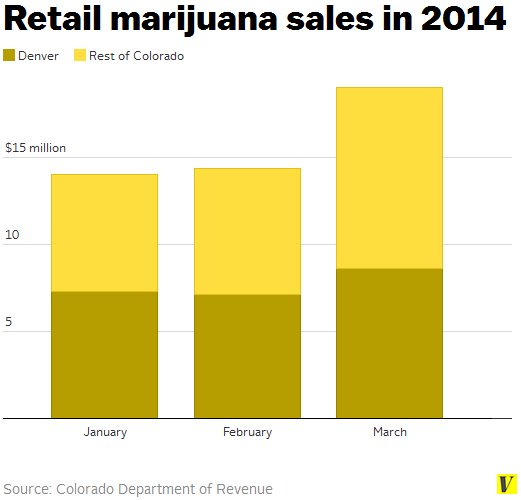
That Denver makes up such a huge chunk of the state's marijuana revenue isn't really surprising. As of May 1, the city's stores held roughly 58 percent of the retail marijuana licenses across the state.
Violent and property crimes are down in Denver
The Denver Police Department's crime data shows that violent crime from January through April dropped by 5.6 percent compared to the same time period last year, and robberies in particular fell by 4.8 percent.
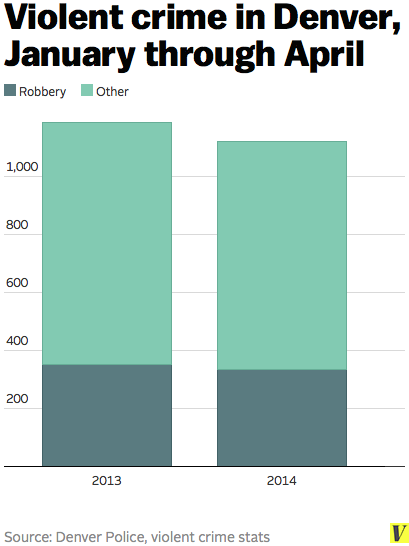
Major property crimes also dropped by 11.4 percent, with burglaries falling by 4.7 percent, compared to the same time last year.
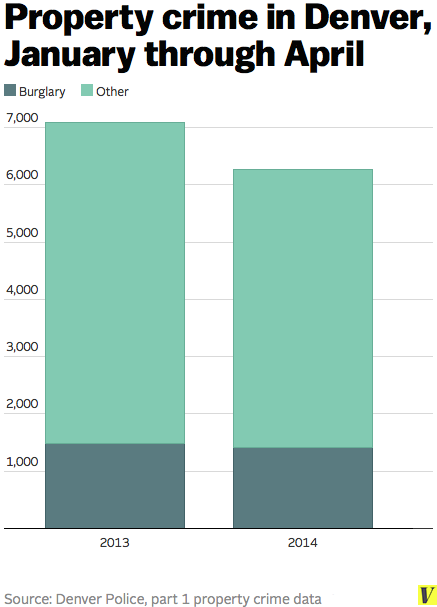
This doesn't mean that legal pot caused less crime, since correlation does not equal causation. But these trends are actually better than my previous check-in with Denver's crime rates. As I reported back then, Denver's crime rates didn't skyrocket during the first two months of retail sales. Now, however, crime seems to be dropping almost across the board, even as federal prohibition forces marijuana businesses to engage in risky banking practices.
All of that is despite warnings from law enforcement officials that crime, particularly robberies and burglaries, would rise following legalization. Two months back, Denver District Attorney Mitch Morrissey told me that legal marijuana was already causing more crimes. But if that's the case, it's not showing up in the city's crime statistics.
Some opponents of legalization, however, have warned that it could take much longer for legal marijuana's crime effects to show up. Tom Gorman, director of Rocky Mountain High Intensity Drug Trafficking Area, said in a previous interview that the full effects won't surface until three to four years at best.
"This is a great opportunity for us to find out what happens when you legalize a substance like marijuana," Gorman said. "Just wait and watch what happens in these labs, and then you can make a decision based on data and facts and not rhetoric."
http://www.vox.com/2014/5/13/5711370/si ... me-is-down
If America's first marijuana legalization experiment is any indication, the end of prohibition can start smoothly.
Since retail sales of recreational marijuana began in Colorado, revenues from marijuana sales have continued trending up. At the same time, crime in Denver, home of most recreational marijuana shops in the state, has dropped nearly across the board.
Colorado and Denver's experiment with legalization is, in other words, going well. The state is seeing its coffers filled with some extra revenue, as expected. And crime, despite warnings from law enforcement officials, isn't rising.
Marijuana revenue is trending up
The state sold nearly $19 million worth of recreational pot in March, up from $14 million in January and February. For all three months, Denver County made up about half that revenue.
That Denver makes up such a huge chunk of the state's marijuana revenue isn't really surprising. As of May 1, the city's stores held roughly 58 percent of the retail marijuana licenses across the state.
Violent and property crimes are down in Denver
The Denver Police Department's crime data shows that violent crime from January through April dropped by 5.6 percent compared to the same time period last year, and robberies in particular fell by 4.8 percent.
Major property crimes also dropped by 11.4 percent, with burglaries falling by 4.7 percent, compared to the same time last year.
This doesn't mean that legal pot caused less crime, since correlation does not equal causation. But these trends are actually better than my previous check-in with Denver's crime rates. As I reported back then, Denver's crime rates didn't skyrocket during the first two months of retail sales. Now, however, crime seems to be dropping almost across the board, even as federal prohibition forces marijuana businesses to engage in risky banking practices.
All of that is despite warnings from law enforcement officials that crime, particularly robberies and burglaries, would rise following legalization. Two months back, Denver District Attorney Mitch Morrissey told me that legal marijuana was already causing more crimes. But if that's the case, it's not showing up in the city's crime statistics.
Some opponents of legalization, however, have warned that it could take much longer for legal marijuana's crime effects to show up. Tom Gorman, director of Rocky Mountain High Intensity Drug Trafficking Area, said in a previous interview that the full effects won't surface until three to four years at best.
"This is a great opportunity for us to find out what happens when you legalize a substance like marijuana," Gorman said. "Just wait and watch what happens in these labs, and then you can make a decision based on data and facts and not rhetoric."
http://www.vox.com/2014/5/13/5711370/si ... me-is-down
Norwegian Professor: Alcohol is More Dangerous than Cannabis
21.05.2014 - Oslo
Norwegian Professor: Alcohol is More Dangerous than Cannabis
Professor Willy Pedersen argues alcohol use should be taken more seriously; cannabis can be legalized in Norway.
Professor Willy Pedersen from University of Oslo opens a new debate on alcohol and drug policy in Norway. Alcohol should be the first priority. But the government has an indecisive alcohol policy that might lead major problems, according to Pedersen.
- It is much easier to talk about weed, it does not affect most people. People like to talk about marijuana, but not about their own alcohol consumption, he said to Aftenposten.
Pedersen also believes that "war on drug" emphasising on policing and punishment is outdated and the alternative approaches including legalization should be investigated.
- Two U.S. states have legalized cannabis, and we should pay close attention to what happens there. If the experiences are good and consumption is not increasing, I think we should consider to follow the same policy. There are two reasons: Cannabis is less dangerous than alcohol. Moreover a lot of money pumped into organized crime. Many young people are drawn into criminal networks that way, says he.
How dangerous is marijuana?
Pedersen further notes that there are two types of damage from marijuna: Some come from actual use. Here cannabis ranks slightly lower than tobacco and alcohol, but they are very harmful substances. The second type is related to its illegality. This means that users must enter in a criminal system to get access to dangerous substances. When we take this into account, the use of the substance is extremly dangerous, especially for very young people. My advice is always to stay away, adds he.
http://www.tnp.no/norway/panorama/4488-norwegian-professor-alcohol-is-more-dangerous-than-cannabis-norway
Norwegian Professor: Alcohol is More Dangerous than Cannabis
Professor Willy Pedersen argues alcohol use should be taken more seriously; cannabis can be legalized in Norway.
Professor Willy Pedersen from University of Oslo opens a new debate on alcohol and drug policy in Norway. Alcohol should be the first priority. But the government has an indecisive alcohol policy that might lead major problems, according to Pedersen.
- It is much easier to talk about weed, it does not affect most people. People like to talk about marijuana, but not about their own alcohol consumption, he said to Aftenposten.
Pedersen also believes that "war on drug" emphasising on policing and punishment is outdated and the alternative approaches including legalization should be investigated.
- Two U.S. states have legalized cannabis, and we should pay close attention to what happens there. If the experiences are good and consumption is not increasing, I think we should consider to follow the same policy. There are two reasons: Cannabis is less dangerous than alcohol. Moreover a lot of money pumped into organized crime. Many young people are drawn into criminal networks that way, says he.
How dangerous is marijuana?
Pedersen further notes that there are two types of damage from marijuna: Some come from actual use. Here cannabis ranks slightly lower than tobacco and alcohol, but they are very harmful substances. The second type is related to its illegality. This means that users must enter in a criminal system to get access to dangerous substances. When we take this into account, the use of the substance is extremly dangerous, especially for very young people. My advice is always to stay away, adds he.
http://www.tnp.no/norway/panorama/4488-norwegian-professor-alcohol-is-more-dangerous-than-cannabis-norway
"If you look at the drug war from a purely economic point of view, the role of the government is to protect the drug cartel."
- Milton Friedman
- Milton Friedman
The FBI Is Struggling to Hire Hackers Who Don't Smoke Weed
The FBI Is Struggling to Hire Hackers Who Don't Smoke Weed
The FBI has a problem. The agency needs to hire hackers to build out its cyber crime division, but it also will not hire anyone who's smoked weed in the past three years. And guess what? A lot of hackers like to smoke weed.
It's a real conundrum. However, it's a conundrum the FBI is working through. On Monday—the same day the agency made headlines by issuing wanted posters for Chinese Army hackers—FBI director James Comey told an audience at the White Collar Crime Institute about this little pot problem. "I have to hire a great work force to compete with those cyber criminals, and some of those kids want to smoke weed on the way to the interview," Comey said. Exactly how to do that is the hard part. Comey added that the agency is "grappling with the question right now."
So does this mean the FBI is looking to hire stoners? No, probably not. It does look like our friends in federal law enforcement are warming up to the idea of hiring people that like to take part in a fun activity that's legal in two states and practically legal in many more, though. In fact, Comey even told a member of the audience that his friend "should go ahead and apply," even if he's worried about the policy. And so can you.
http://gizmodo.com/the-fbi-is-struggling-to-hire-hackers-who-dont-smoke-we-1579183208
The FBI has a problem. The agency needs to hire hackers to build out its cyber crime division, but it also will not hire anyone who's smoked weed in the past three years. And guess what? A lot of hackers like to smoke weed.
It's a real conundrum. However, it's a conundrum the FBI is working through. On Monday—the same day the agency made headlines by issuing wanted posters for Chinese Army hackers—FBI director James Comey told an audience at the White Collar Crime Institute about this little pot problem. "I have to hire a great work force to compete with those cyber criminals, and some of those kids want to smoke weed on the way to the interview," Comey said. Exactly how to do that is the hard part. Comey added that the agency is "grappling with the question right now."
So does this mean the FBI is looking to hire stoners? No, probably not. It does look like our friends in federal law enforcement are warming up to the idea of hiring people that like to take part in a fun activity that's legal in two states and practically legal in many more, though. In fact, Comey even told a member of the audience that his friend "should go ahead and apply," even if he's worried about the policy. And so can you.
http://gizmodo.com/the-fbi-is-struggling-to-hire-hackers-who-dont-smoke-we-1579183208
"If you look at the drug war from a purely economic point of view, the role of the government is to protect the drug cartel."
- Milton Friedman
- Milton Friedman
Palaa sivulle “Politiikka ja media”
Paikallaolijat
Käyttäjiä lukemassa tätä aluetta: Ei rekisteröityneitä käyttäjiä ja 17 vierailijaa